
Are you trying to find a reliable whole-house water filtration solution that reduces heavy metals, chloramine, sediment, odor, and VOCs while being easy to install and maintain?
Quick verdict
You get a robust, flexible whole-house filtration system with the HQUA WF3-02 3-Stage Free-Standing Whole House Water Filtration System, Reduces Heavy Metals (Lead, Mercury, Copper, Nickel, Chromium), Chloramine, Sediment, Odor, and VOC’s. The system’s three Big Blue housings, pressure gauges, timers, and service-friendly features make it a solid choice if you want point-of-entry protection for drinking water, bathing, laundry, and appliances. It’s particularly attractive if you need heavy-metal and chloramine reduction without complex plumbing changes.
HQUA WF3-02 3-Stage Free-Standing Whole House Water Filtration System, Reduces Heavy Metals (Lead, Mercury, Copper, Nickel, Chromium), Chloramine, Sediment, Odor, and VOC’s
$379.99 In Stock
What the HQUA WF3-02 is and who it’s for
You should see this unit as a point-of-entry (whole-house) filtration package that combines sediment removal, carbon filtration, and a compound GAC+KDF stage for heavy metals and chloramine reduction. If you want cleaner, better-tasting water from every tap and protection for appliances and plumbing, this system is built for you. It suits homeowners who prefer a balance of performance, convenience, and modular serviceability.
Purchase HQUA WF3-02 Whole House Water Filtration System
Key features at a glance
You’ll find multiple design choices and built-in conveniences that aim to simplify installation and maintenance while delivering multi-contaminant reduction.
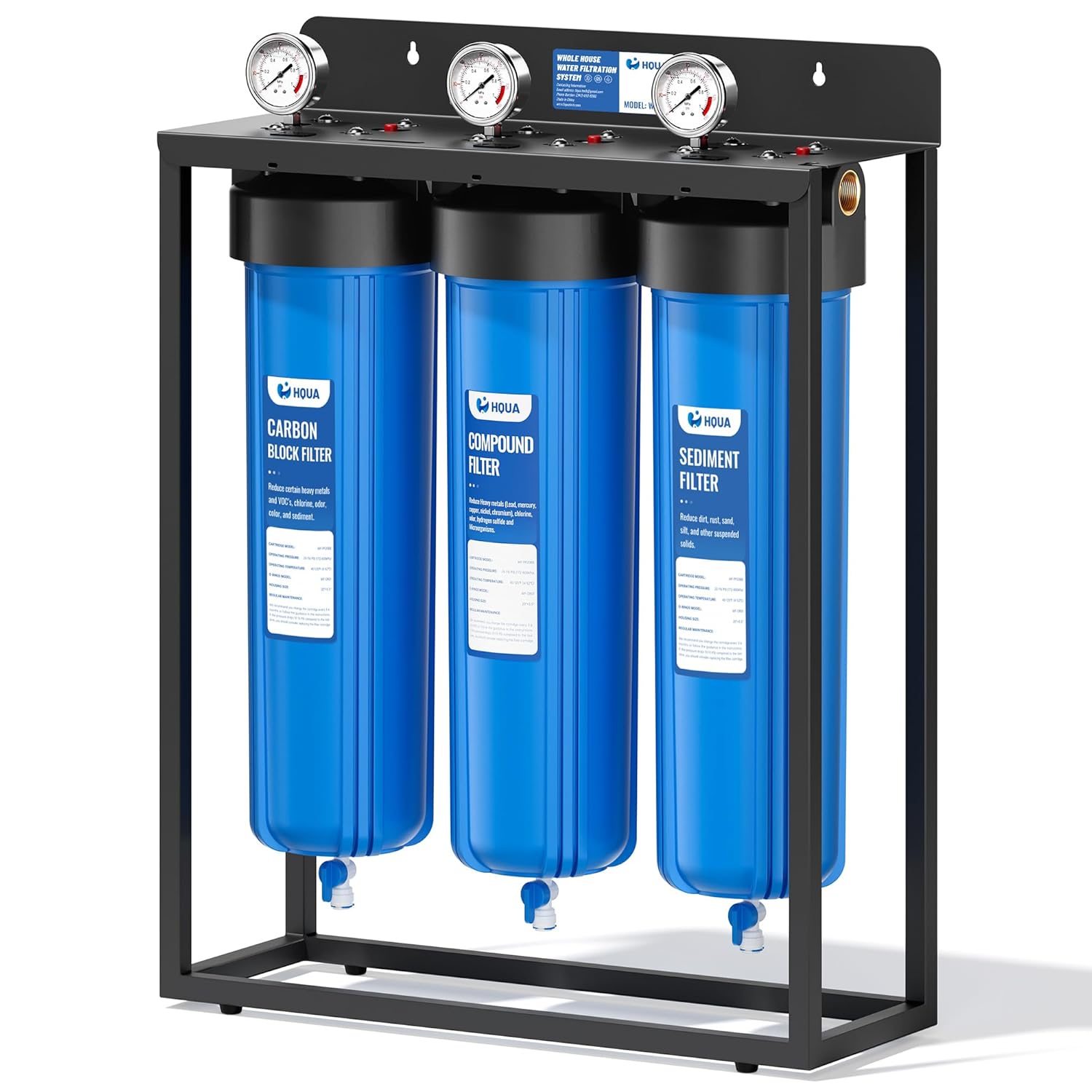
- Flexible installation: free-standing or wall-mounted, so you can adapt it to your utility room, basement, or garage.
- Three Big Blue 20”×5.5” filter housings: larger cartridges for higher capacity and lower pressure drop versus standard housings.
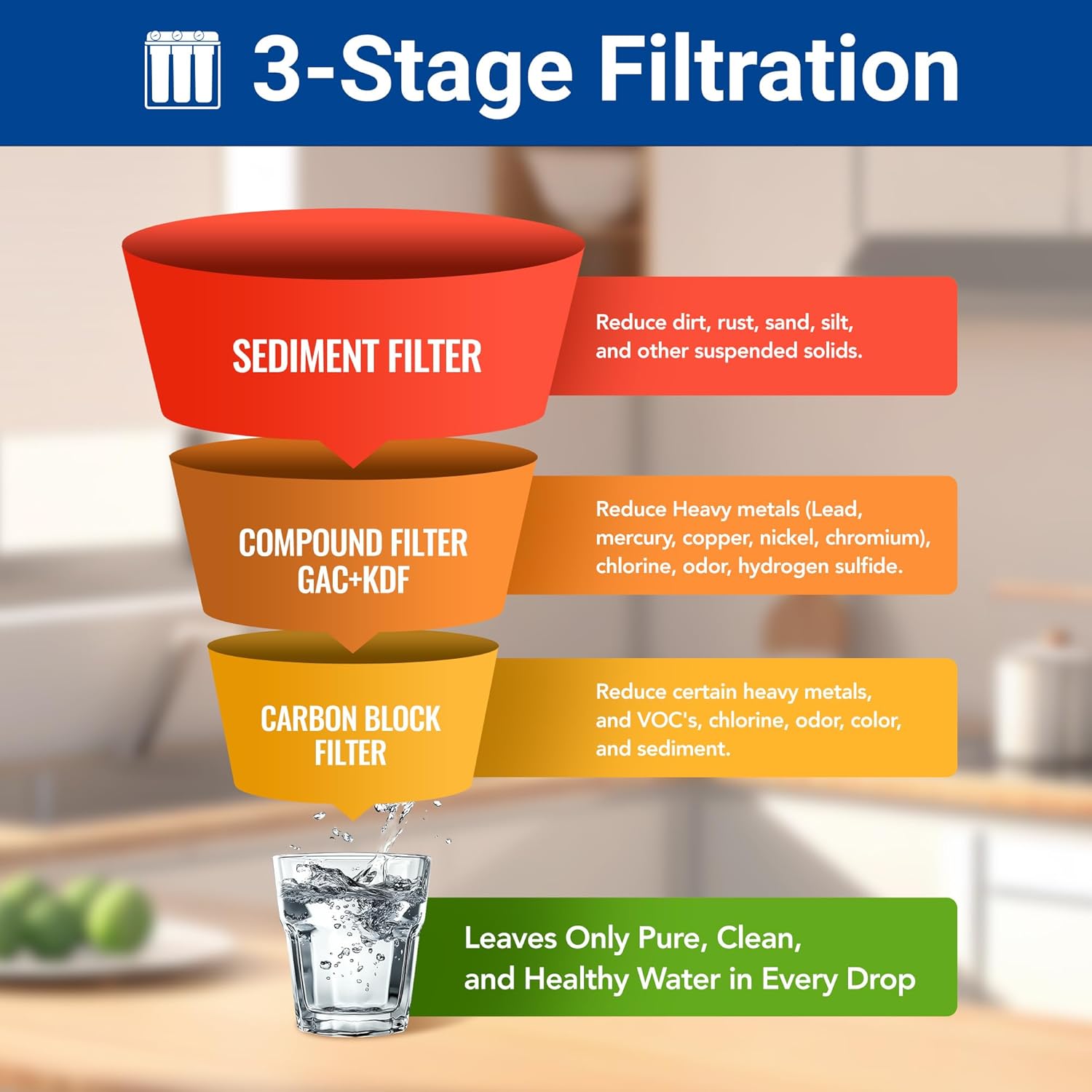
- Sediment + Carbon Block + Compound GAC+KDF stages: staged contaminant reduction for improving taste, odor, and heavy metal removal.
- Pressure gauges and 180-day countdown timers: help you monitor filter performance and plan replacements.
- Maintenance-friendly valves and cleaning brush: pressure relief, drain valves, and a long brush for easy servicing.
- Flexible pipe fittings and maintenance record card: adapters for 3/4” or 1” NPT and documentation to track changes.
Product specifications
You’ll want to know the physical and component specs before you buy. These basics help you assess fit, compatibility, and whether you’ll need extra plumbing parts.
| Specification | Details |
|---|---|
| Model | HQUA WF3-02 3-Stage Free-Standing Whole House Water Filtration System |
| Filter housings | Three Big Blue 20″ x 5.5″ (20”×5.5”) |
| Filtration stages | Sediment filter → Carbon block filter → Compound GAC+KDF filter |
| Contaminants targeted | Sediment, dirt, rust, sand, silt, suspended solids, chlorine/chloramine, heavy metals (lead, mercury, copper, nickel, chromium), odor, VOCs |
| Installation | Floor-standing or wall-mounted |
| Dimensions | 28” high × 23” wide × 8” deep |
| Plumbing adaptability | Adapters included to convert inlet/outlet to 3/4” NPT or 1” NPT |
| Monitoring | Multiple pressure gauges; built-in 180-day countdown timers |
| Maintenance aids | Pressure relief valve, drain valve, long housing cleaning brush, maintenance record card |
| Flow direction | No specific flow direction required (cartridges can be installed either way) |

How the three stages work — what each stage does for your water
You’ll understand how contaminants are handled when each stage’s role is clear. This is a staged filtration approach: coarse protection, adsorptive polishing, and chemically active reduction.
Stage 1 — Sediment filter
You’ll capture large particles like sand, silt, rust, and dirt here, which protects downstream filters and reduces turbidity. This stage is essential for preventing premature clogging of the carbon and GAC+KDF media.
Stage 2 — Carbon block filter
You’ll get adsorption of chlorine, organic tastes and odors, and many VOCs with the carbon block stage. It improves water taste and helps the subsequent stage work more efficiently by removing chlorine that can otherwise reduce the life or effectiveness of KDF/GAC.
Stage 3 — Compound GAC+KDF filter
You’ll see reduction of heavy metals (lead, mercury, copper, nickel, chromium) and chloramine with the compound GAC + KDF blend. KDF media use redox reactions to reduce dissolved metals and neutralize chlorine/chloramine compounds, while GAC adsorbs organic chemicals and improves taste and odor further.
Installation and setup
You’ll appreciate the flexibility and the choices you can make during installation, but you’ll still need to prepare and possibly hire a plumber depending on your local code and your comfort with basic plumbing.
Location and mounting options
You’ll be able to install the system floor-standing for stability or wall-mount it to save space. Think about access for servicing—allow clearance to remove housings and replace cartridges easily.
Plumbing connections and fittings
You’ll get adapters to convert inlet/outlet to 3/4” or 1” NPT, which simplifies matching local pipe sizes. You should turn off water and relieve pressure before cutting into supply lines, and consider adding shut-off valves upstream and downstream for maintenance convenience.
Tools and preparation
You’ll need basic plumbing tools: pipe cutter, wrenches, Teflon tape, and possibly a drill for wall mounting. If you’re not comfortable with the required plumbing changes or with tying into the main supply, you should consider hiring a licensed plumber to ensure a code-compliant installation.

Performance and contaminant reduction
You’ll want to know what this system can and cannot guarantee. Manufacturer claims include removal or reduction of many heavy metals, chloramine, sediment, odor, and VOCs; real-world performance depends on cartridge media, water chemistry, and flow rates.
Heavy metals and chloramine
You’ll benefit from the GAC+KDF stage designed to reduce lead, mercury, copper, nickel, and chromium as well as chloramine. KDF media use electrochemical (redox) mechanisms to convert soluble metals to insoluble forms that can be trapped or flushed away, which offers effective reduction in many conditions.
Sediment and turbidity
You’ll see a substantial reduction in visible particles and turbidity thanks to the first-stage sediment cartridge and the large Big Blue housings that accept higher-capacity filters. This helps protect appliances and reduces staining on fixtures and fabrics.
VOCs, taste, and odor
You’ll notice better-tasting and smelling water because of the carbon block and GAC components, which adsorb VOCs and organic compounds responsible for taste and odor. Carbon block is particularly effective at improving water aesthetics.
Flow rate and capacity considerations
You’ll enjoy higher potential flow rates than smaller housings due to the Big Blue cartridges, but exact flow rates and capacity are influenced by incoming water quality and the specific cartridges used. If you have high sediment loads or very hard water, cartridge life and flow will be reduced, so actual throughput varies.
Maintenance and ongoing costs
You’ll want to plan for regular servicing so you don’t lose performance. The system adds conveniences to help you stay on top of maintenance.
Filter replacement schedule
You’ll see built-in 180-day (six-month) countdown timers that remind you when cartridges are due to be replaced. Keep in mind that heavy use or poor source water may require more frequent changes; always base replacement on pressure drop, taste, or turbidity changes in addition to the timer.
Pressure monitoring and troubleshooting
You’ll use the multiple pressure gauges to detect clogging; increasing pressure drop across stages indicates the need for replacement. These gauges let you stagger cartridge replacements (you don’t have to change all three at once unless all show significant restriction).
Service-friendly design features
You’ll appreciate pressure relief and drain valves that make cartridge changeouts faster and safer, plus a long housing cleaning brush to scrub the inside during service. The maintenance record card helps you track dates, starting pressures, and cartridge life for predictable upkeep.
Cartridge cost considerations
You’ll pay for replacement cartridges periodically; costs vary by cartridge type and brand. Because the housings are Big Blue, the cartridges are larger and often more expensive per piece than standard housings, but they offer longer life and lower replacement frequency. Factor in cartridge pricing and expected lifespan when calculating total cost of ownership.
Safety and water quality considerations
You’ll need to verify and test before and after installation to confirm performance and ensure the system meets your specific contaminant concerns.
Testing before installation
You’ll want to test your incoming water—especially for heavy metals, chloramine, hardness, and bacterial contamination—so you can choose the right system and cartridges. If you have bacterial contamination or highly turbid water, a different treatment (UV, chlorination, or specialized media) might be required.
Certifications and standards
You’ll notice that product literature may not list NSF/ANSI certifications for each contaminant. If third-party certs are important to you, check with the manufacturer for documentation or consider systems with validated, certified media. Testing and independent lab reports can provide additional assurance.
Softening and scale issues
You’ll want to consider water hardness: KDF and carbon media can be impacted by scale buildup. If your water is very hard, you should consider a water softener pre-treatment to prevent scale from shortening cartridge life and reducing effectiveness.
Pros and cons
You’ll find this section useful when weighing whether this system matches your needs and priorities.
Pros
- You’ll get flexible installation (floor-standing or wall-mounted) to fit many spaces.
- You’ll benefit from large-capacity Big Blue housings that lower pressure drop and extend cartridge life.
- You’ll have multi-stage contaminant reduction targeting sediment, chlorine/chloramine, VOCs, and several heavy metals.
- You’ll appreciate maintenance aids: pressure gauges, 180-day timers, pressure-relief/drain valves, and a cleaning brush.
- You’ll have plumbing adapters to match common pipe sizes.
Cons
- You’ll need to confirm certification claims if you require third-party validation for specific contaminant removal.
- You’ll likely need larger replacement cartridges that may be more expensive than standard sizes.
- You’ll have variable cartridge life depending on incoming water quality; heavy contamination or high flow demands will increase replacement frequency.
- You’ll still need plumbing experience or a professional plumber for some installations, depending on local code.
Side-by-side comparison with other whole-house options
You’ll want to compare this unit to alternatives like under-sink point-of-use filters, whole-house water softeners, and other whole-house filtration systems.
Whole-house vs point-of-use
You’ll get full-house protection with the HQUA WF3-02 versus filtered water only at a single tap with under-sink systems. If you want better water for bathing, laundry, and every faucet, whole-house is the right choice; if you only need drinking water filtration, a point-of-use system may be more cost-effective.
Big Blue housings vs standard housings
You’ll experience higher capacity and less frequent changes with Big Blue housings compared to standard 10” housings. This typically means fewer service interruptions and better flow retention under demand, but a higher upfront cartridge cost.
This system vs a water softener
You’ll notice that this filter targets sediment, organics, and metals, but it does not remove hardness (calcium and magnesium) like a softener. If you have scale problems, consider pairing with a softener or installing a softener upstream.
Step-by-step maintenance checklist
You’ll find this checklist useful for keeping the system performing well and avoiding surprises.
- Turn off the main water supply to the unit and relieve pressure using the pressure relief valves. You’ll prevent spills and reduce risk during service.
- Open the drain valves to flush housings if needed and remove spent cartridges. You’ll avoid messes and make cartridge removal easier.
- Use the housing cleaning brush to scrub and rinse the interior before inserting new cartridges. You’ll remove sediment build-up and biofilm.
- Install new cartridges in the correct positions: sediment → carbon → GAC+KDF. Although the system does not require a specific flow direction, maintaining stage order preserves intended functionality.
- Close drain valves, open supply valves, and check for leaks. You’ll verify seals and fittings are tight.
- Record starting pressure and replacement date on the maintenance card and reset the 180-day timers. You’ll keep reliable maintenance records and timely reminders.
Troubleshooting common issues
You’ll want quick answers to common problems so you can keep water flowing and safe.
Low flow or pressure drop
You’ll likely encounter pressure drop due to clogged cartridges or excessive sediment load. Check the pressure gauges to determine which stage is restricted and replace the cartridge accordingly.
Persistent taste or odor
You’ll first check if the carbon and GAC+KDF cartridges are past due for replacement; adsorptive media lose capacity over time. You’ll also consider water source changes or contamination that may require additional testing.
Leaks after service
You’ll tighten housings and check O-rings for proper placement and lubrication. Replace damaged O-rings and ensure housings are hand-tight plus a quarter turn with the housing wrench if provided.
Pressure gauge reads unusual values
You’ll confirm gauge connections and zero points; a damaged gauge may need replacement. Use gauges to compare inlet versus outlet readings to isolate issues.
Tips to extend cartridge life and optimize performance
You’ll benefit from practical habits that reduce service frequency and improve filtration outcomes.
- You’ll pre-filter heavily sediment-laden water or install a coarse pre-filter to protect the first stage.
- You’ll lower water temperature where possible; high temperatures reduce KDF and carbon effectiveness.
- You’ll minimize chlorine shocks or changes in source water by monitoring municipal treatment changes and adjusting maintenance intervals accordingly.
- You’ll keep a spare set of cartridges on hand if you live in a remote area or rely heavily on filtered water during certain seasons.
Frequently asked questions (FAQ)
You’ll appreciate a concise set of answers for the most common buyer questions.
Q: How often should you change the filters?
A: The system includes 180-day countdown timers as a baseline, but actual replacement intervals depend on water quality and usage. Monitor pressure gauges and taste/odor changes to determine earlier replacement if needed.
Q: Does it remove bacteria and viruses?
A: The standard sediment/carbon/GAC+KDF configuration is not specifically a microbiological barrier like a UV disinfection system or 0.2-micron absolute membrane. If you suspect bacterial contamination, you should test the water and consider adding a UV sterilizer or certified microbiological filter.
Q: Can you install it indoors and outdoors?
A: You’ll typically install indoors or in an enclosed, frost-free location. Freezing temperatures can damage housings and media, so avoid outdoor placements unless adequately insulated and protected.
Q: Will it handle very hard water?
A: You’ll find KDF and carbon media can be impacted by scale from hard water. Consider a water softener upstream if you have significant hardness to protect media life and performance.
Q: Is professional installation required?
A: You’ll be able to DIY if you’re comfortable with plumbing. For compliance with local codes or if you prefer peace of mind, hire a licensed plumber.
Final thoughts and buying considerations
You’ll likely be satisfied if you want a user-friendly, whole-house system that targets sediment, chlorine/chloramine, VOCs, and several heavy metals. The HQUA WF3-02’s large housings, pressure gauges, timers, and maintenance aids make it practical for homeowners who want reliable point-of-entry filtration without overly complex controls.
Before you buy, you’ll want to:
- Test your water to understand which contaminants are present and their concentrations.
- Confirm cartridge availability and replacement cost for your budget.
- Decide whether certification (NSF/ANSI) is required for your peace of mind and check with the manufacturer if you need documentation.
- Consider pairing with a water softener or UV system if you have specific hardness or microbiological concerns.
If you want cleaner, safer water across every tap with an emphasis on heavy-metal and chloramine reduction, you’ll find the HQUA WF3-02 a competitive, serviceable option.
Disclosure: As an Amazon Associate, I earn from qualifying purchases.