
Do you want reliable whole-home filtration that specifically targets iron, manganese, chlorine, sediment, taste, and odor?
Buy ISpring WGB32BM Whole House Water Filter On Amazon
Product overview
You’re looking at the iSpring Whole House Water Filter System, Reduces Iron, Manganese, Chlorine, Sediment, Taste, and Odor, 3-Stage Iron Filter Whole House, Model: WGB32BM. This system is built to sit on your main water supply line and treat all the water that enters your home, protecting appliances, fixtures, and your family from iron, manganese and a host of other common contaminants. You’ll keep healthy minerals in your water since this is not a reverse osmosis unit and will not reduce total dissolved solids (TDS).
What’s included and packaging
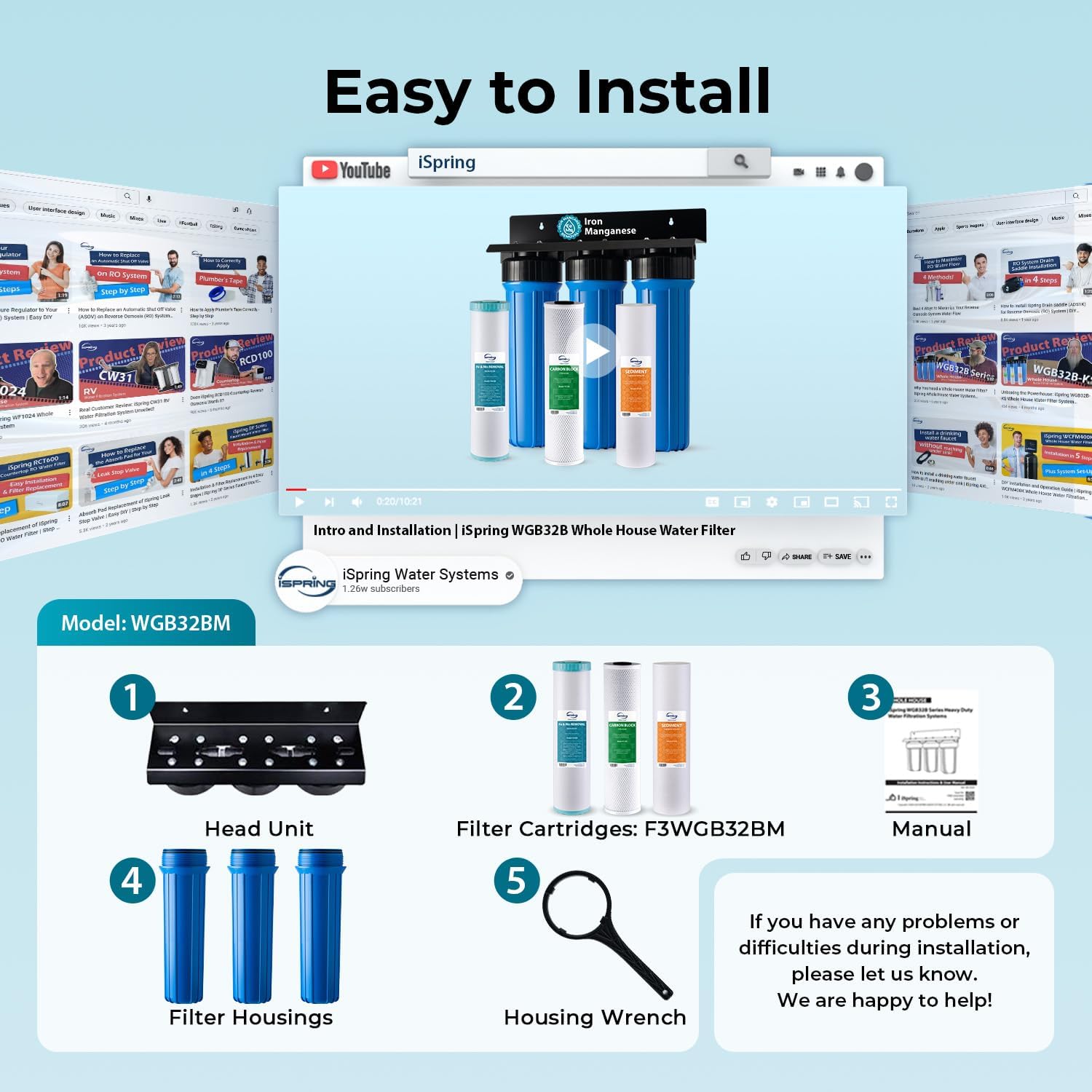
You’ll receive the three-stage housings and cartridges sized 20 in. x 4.5 in., with cartridges individually wrapped to ensure freshness before installation. The package also includes the iron-targeting FM25B media cartridge, the coconut shell carbon block cartridge, and a high-capacity polypropylene sediment filter; refer to the manual and the company’s YouTube videos for step-by-step guidance. You should unwrap the cartridges before use and register the product to activate warranty and support.
Key specifications
You’ll want a quick snapshot to compare specs and verify fit for your plumbing and water usage. This table summarizes the main technical details so you can quickly check compatibility and performance expectations.
| Feature | Details |
|---|---|
| System model | iSpring WGB32BM (3-stage whole house iron filter) |
| Filtration stages | 3 (sediment → carbon block → iron/manganese catalytic media) |
| Sediment rating | 5 microns (stage 1 polypropylene) |
| Carbon type | Coconut shell carbon block (stage 2) |
| Iron/Manganese media | FM25B catalytic media (stage 3) |
| Iron removal capacity | Effective up to 3.0 ppm iron |
| Manganese removal capacity | Effective up to 1.0 ppm manganese |
| Flow rate | Up to 15 GPM (minimum impact on household flow) |
| Inlet/outlet connection | 1 in. NPT |
| Cartridge size | 20 in. x 4.5 in. |
| Cartridge capacity | Each filter rated for up to 100,000 gallons |
| Coverage | Typically 1 year supply for a family of four (per manufacturer) |
| Standards | Filters are independently third-party tested to meet NSF/ANSI standards |
| Warranty/support | 1-year manufacturer warranty after registration; lifetime free tech support in U.S. |
| TDS reduction | Does NOT reduce total dissolved solids (keeps healthy minerals) |

iSpring Whole House Water Filter System, Reduces Iron, Manganese, Chlorine, Sediment, Taste, and Odor, 3-Stage Iron Filter Whole House, Model: WGB32BM
Performance
You’ll get a system designed to handle multiple contaminant types without causing significant pressure drop in typical residential plumbing. With a rated maximum flow of 15 gallons per minute, the system is suitable for most single-family homes and won’t noticeably restrict showers or multiple simultaneous water uses for most households.
How effective is it at removing iron and manganese?
You’ll see good results for moderate iron and manganese issues—this system is designed for iron up to 3.0 ppm and manganese up to 1.0 ppm. The FM25B catalytic media isn’t consumed in the chemical process, so it typically lasts longer than traditional greensand media, which is a practical advantage if you have these contaminants at or below the recommended concentrations.
Chlorine, sediment, taste, and odor removal
You’ll notice clearer water and improved taste because the first two stages target sediment and chlorine/organic chemicals. The polypropylene sediment filter captures particles down to 5 microns, while the coconut shell carbon block reduces chlorine, rust residue, harmful organic compounds, herbicides, and some industrial solvents that contribute to bad taste and odor.
Purchase The ISpring WGB32BM Whole-house Filter
Filtration stages explained
You’ll want to know exactly what each stage does so you can plan maintenance and anticipate the type of water quality improvements to expect. The three stages work together to trap particles, adsorb chemicals, and target iron/manganese.
Stage 1 — Polypropylene sediment filter (5 microns)
You’ll depend on this first line of defense to remove sand, silt, rust flakes, and larger particulates that could foul downstream media. The high-capacity design helps extend the life of the carbon and iron media by keeping bigger particles out of those stages.
Stage 2 — Coconut shell carbon block
You’ll get efficient chlorine and organic chemical reduction from this stage; coconut shell carbon is chosen for taste and odor improvement and for high adsorption efficiency. The carbon block format provides consistent flow and higher contact time than loose granular carbon, improving removal of VOCs and many chemicals that cause unpleasant tastes and smells.
Stage 3 — FM25B catalytic iron/manganese media
You’ll appreciate that this catalytic media specifically targets ferrous (dissolved) iron and manganese as well as some oxidized forms. Because the media isn’t consumed in the chemical reaction, it tends to last longer than some traditional iron filter media, making it a favorable option for homes with moderate iron and manganese levels within the stated range.
Contaminants removed and limitations
You’ll benefit from wide coverage of common contaminants, but it’s important to know the limitations so you can choose additional treatment if needed.
What it removes well
You’ll see removal or reduction of:
- Sediment, rust particles, and suspended solids (≥5 microns).
- Chlorine and many chlorine byproducts that cause bad taste and odor.
- Dissolved iron (up to 3.0 ppm) and manganese (up to 1.0 ppm) with the FM25B.
- Some herbicides, industrial solvents, and common VOCs captured by the carbon block.
What it does not remove or reduce effectively
You’ll need other systems for:
- Total dissolved solids (TDS) — the system intentionally preserves healthy minerals.
- Fluoride, nitrates, and many dissolved inorganic ions — use RO or dedicated filters for those.
- Microbial contaminants (bacteria, viruses, cysts) — if you have microbial issues, add a UV sterilizer or other microbial disinfection step.
- Very high iron or manganese concentrations above manufacturer limits — you’ll need a different or pre-treatment system.

Installation and your DIY experience
You’ll find installation is intended to be DIY-friendly if you’re comfortable with basic plumbing. iSpring provides a manual and helpful YouTube videos to walk you through the process, and the 1 in. NPT inlet/outlet fittings match standard plumbing for many homes.
What you’ll need and estimated time
You’ll likely complete a straightforward installation in a couple of hours if you have basic tools and a clear main water shutoff. Expect to need:
- Pipe wrenches, Teflon tape, pipe cutters (if altering pipe), and mounting hardware.
- Possibly adapters if your existing plumbing uses different thread sizes or materials.
- A place with space for three 20 in. cartridges and clearance to change cartridges annually.
Plumbing considerations and placement
You’ll install the system at the main water supply line to treat every outlet. Place it where you can access the housings for cartridge changes and where freezing won’t be an issue. If your water source is a well or you have corroded piping, consider pre-flushing and checking compatibility with your plumbing material.
Flow rate, pressure, and household impact
You’ll experience up to 15 GPM in most setups, which is enough to support typical household demand for a family of four. This rating keeps showers, washing machines, and multiple taps functioning without major flow loss in most situations.
What affects flow and pressure
You’ll see flow influenced by your household demand, plumbing condition, and filter life—the more the filters load up with sediment and particulates, the greater the pressure drop over time. Replacing cartridges on schedule will maintain optimal flow.

Maintenance and filter replacement
You’ll need to plan for annual maintenance in many cases, although actual intervals depend on your water quality and household usage. Both the sediment and carbon block cartridges are rated for 100,000 gallons each, and the manufacturer estimates that a family of four will get approximately one year of use from them.
Cartridge replacement schedule
You’ll typically replace the sediment and carbon cartridges annually if your usage aligns with the manufacturer’s capacity estimates. Replace earlier if you notice reduced flow, worsening taste/odor, or visible sediment bypassing the first stage. The FM25B iron media may last longer depending on type and load of iron/manganese present because the media is catalytic and not consumed in the process.
How to replace cartridges
You’ll shut off the main water supply, relieve housing pressure, open housings, remove the old cartridges, unwrap and install fresh cartridges, then reassemble and check for leaks. The housings are designed for user-friendly access, but make sure you have an appropriate spanner wrench or the correct size hand strength to avoid damage.
Expected maintenance costs
You’ll encounter recurring costs for replacement cartridges; costs vary by supplier and region. Check current prices from iSpring or authorized dealers and budget for an annual filter change for most households. Lifetime tech support can help with part numbers and ordering.
Testing and when you need additional treatment
You’ll benefit from testing your water before purchasing and periodically afterward to verify the system’s performance. Knowing your water chemistry helps you determine whether this system alone is sufficient.
What water tests to run
You’ll want a baseline test for iron, manganese, hardness, pH, TDS, and basic microbiological tests if your source is a private well. If iron exceeds 3.0 ppm or manganese exceeds 1.0 ppm, you’ll likely need a different or additional treatment system. High hardness or iron staining might also justify a softener or specialized iron filter.
Adding treatments for specific problems
You’ll consider pairing this system with additional equipment depending on test results—options include:
- Water softener for high hardness or iron that’s causing scale.
- UV sterilizer for microbial contamination.
- Reverse osmosis for low-TDS drinking water needs or to remove specific dissolved ions.
Pros and cons
You’ll want a clear list of advantages and drawbacks to decide whether this system is right for your needs.
Pros
- You’ll get multi-contaminant reduction (sediment, chlorine, taste/odor, iron, manganese) in a single, inline system that treats all home water.
- You’ll maintain household flow with up to 15 GPM capacity and 1 in. NPT plumbing compatibility.
- You’ll save on maintenance compared with media that gets consumed, because the catalytic FM25B media lasts longer than greensand.
- You’ll benefit from third-party testing to NSF/ANSI standards, a one-year warranty, and lifetime U.S.-based tech support.
- You’ll preserve healthy minerals because the system does not reduce TDS.
Cons
- You’ll need additional systems to handle bacteria, viruses, nitrates, fluoride, or very high levels of dissolved solids.
- You’ll have to replace cartridges regularly; actual lifespan depends on local water quality and usage.
- You’ll be limited by the iron and manganese maximums—if your water exceeds those, the system won’t be adequate alone.
- You’ll need space at the main water line and clearance for 20 in. cartridges and annual maintenance.
Comparison and alternatives
You’ll want to weigh this system against other whole-home filtration options to make the best choice for your water chemistry and budget.
Versus reverse osmosis (RO)
You’ll get whole-home coverage with the iSpring WGB32BM, while RO systems are typically point-of-use and remove TDS including beneficial minerals. If you want drinking water with near-zero TDS, you’ll add an RO at the kitchen sink. For whole-house TDS reduction, whole-home RO systems exist but are rare and costly.
Versus greensand and backwashing iron filters
You’ll find greensand media requires regeneration and can be consumed over time, whereas the FM25B catalytic media used here is not consumed and generally requires less frequent media replacement. Backwashing iron filters handle very high iron loads and oxidized iron better in some cases, but they’re more complex, require drain access, and need a regeneration/oxidation process.
Versus water softeners
You’ll get iron and manganese reduction with this system, but it won’t soften water the way a salt-based or salt-free softener does. If you have hard water causing scale, consider combining this filter with a softener or choosing a softener that also tackles iron.
Who should buy this system
You’ll benefit from this system if you have municipal or well water with moderate iron and manganese, chlorine taste or odor issues, and sediment problems, and you want a whole-house solution that preserves healthy minerals. If you’re seeking point-of-use ultra-purified drinking water, or you have very high contaminant concentrations or microbial contamination, plan on adding additional treatment.
Troubleshooting and practical tips
You’ll be able to solve many common issues yourself with a little guidance, and the manufacturer’s tech support can help with more unusual problems.
Common issues and fixes
You’ll notice reduced flow when cartridges are near the end of life—replace the sediment and carbon cartridges to restore flow. You’ll check seals and O-rings if you detect leaks after reassembly and replace them if they’re worn. If the water still tastes off after a cartridge change, verify you installed the carbon block correctly and consider pre-flushing and testing your water for contaminants not addressed by this system.
Tips to maximize performance
You’ll test water before installation and at intervals after to track performance. You’ll keep spare cartridges on hand so you can change them promptly when capacity approaches the rated 100,000 gallons. You’ll mount the housings with clearance and keep a small supply of replacement O-rings and approved lubricants handy.
Frequently asked questions (FAQs)
You’ll likely have practical questions before buying—these address the most common ones.
Q: Will this system remove hard water minerals?
A: No. You’ll keep calcium and magnesium (hardness) and other dissolved minerals. For scale reduction, consider a water softener.
Q: Can this handle bacterial contamination?
A: No. You’ll need an additional UV sterilizer or chemical disinfection for bacteria and viruses.
Q: How often should I change filters?
A: You’ll generally change the sediment and carbon cartridges about once per year under typical household use; actual timing depends on water quality and gallons used.
Q: What if my iron is higher than 3.0 ppm?
A: You’ll need a more robust iron removal method such as a backwashing iron filter, oxidation + filtration, or multi-stage pre-treatment designed for higher concentrations.
Q: Does it require electricity?
A: You’ll not need electricity for normal operation—the system is passive except for any optional components like boosters or UV systems.
Warranty and support
You’ll get a 1-year manufacturer warranty once you register the product online, and lifetime free tech support from a U.S.-based support team. You’ll benefit from their assistance for installation questions, part numbers, and warranty claims if needed.
How to register and get help
You’ll register online to activate the warranty, and iSpring offers manuals and videos to walk you through setup and maintenance. If you encounter problems, reach out to their support team for troubleshooting and replacement part guidance.
Final verdict
You’ll find the iSpring WGB32BM to be a robust, user-friendly option for most households dealing with moderate iron, manganese, chlorine, sediment, taste, and odor issues—especially if you want whole-house protection and to keep beneficial minerals in your water. You’ll need to test your water first and plan for cartridge replacement, and if you have contaminants outside the system’s design limits, you’ll pair it with additional treatment like a softener, UV, or RO for drinking water.
If you want long-lasting catalytic media for iron and manganese within the specified ranges, reliable carbon-based chlorine and taste/odor removal, and a whole-home solution that’s reasonably DIY-installable, you’ll likely find this iSpring model a solid fit.
Shop ISpring WGB32BM On Amazon
Disclosure: As an Amazon Associate, I earn from qualifying purchases.